As planned I was back on the marsh at Capestang by mid morning. The weather was bright and sunny but with bit of chill in the fresh easterly wind. Almost immediately a couple of White Storks soared over and Purple Herons were noted flying in the distance.
Next the highlight of the day. I met Tomes Poblet a student working for LPO (RSPB equivalent) on a number of projects in the area. Today he was visiting the marsh with Bitterns in mind. His task is a difficult one. He aims to locate the many land owners of the marsh and try to persuade them to agree in principle a management agreement to enhance the habitats on the site. The phragmites reedbeds need a cutting regime introduced and better control of water levels would also be a positive move. Bitterns breed in small numbers at this site.
Some of the owners have already talked to Tomes but do not want their neighbours to know. There is a distinct dislike of any green movement as they see them as a threat to their way of life. That life of course includes hunting. I do hope that eventually they will realise that there is a common interest in protecting the marsh in perpetuity. Hunting and biodiversity in general will benefit from a management plan and resources to put it inplace.
At least I am glad that somebody cares and is trying to make things happen.
Walking with Tomes was a pleasure. We encountered a large flock of migrating Swifts and a single Woodchat Shrike. Large numbers of Yellow Wagtails were also present and Reed and Great Reed Warblers were singing loudly. I managed to hear a snatch of the song of Moustached Warbler but could not set eyes on it. Bearded Tits were also very active in the reedbeds.
Returning to our cars a passing Marsh Harrier flushed many Little Egrets from a marsh and in addition 5 Squacco Herons. The latter are annual but scarce in this area.
Monday, 18 April 2011
Sunday, 17 April 2011
Garden Wildlife
Spent the whole day in our French garden distributing the soil we collected yesterday.
There is always so much to see and it is worth keeping a look out for interesting insects. Today on our flowering hedge I encountered a very splendid green beetle. It was apparently taking nectar and
I have seen these before but I have no idea what it is. Any ideas?
I sat down for a rest on a seat and within minutes this splendid male Common Redstart appeared and began feeding from a perch in the Pyracantha hedge. Other migrants today included a White Wagtail, Sparrowhawk and a female Montagu's Harrier. Our resident Short-toed Eagles were also overhead calling during the morning.
After lunch it became quite warm (23 degrees) and I noted a bit of Ocellated Lizard activity. These large creatures seem to like my drainage pipes and every one has droppings at its entrance. I watched three in all including this one the size of a rat and I wondered how he squeezed down the pipe.
With the work now done for a while I intend to go back to the marsh at Capestang tomorrow to see how things might have changed.
Saturday, 16 April 2011
Just when I thought the day was over
I stepped outside around 10.30pm to admire the splendid night sky with almost a full moon when I enjoyed the first "sonic" calls of a Scops Owl. They nest nearby and we enjoy their calling all summer long.
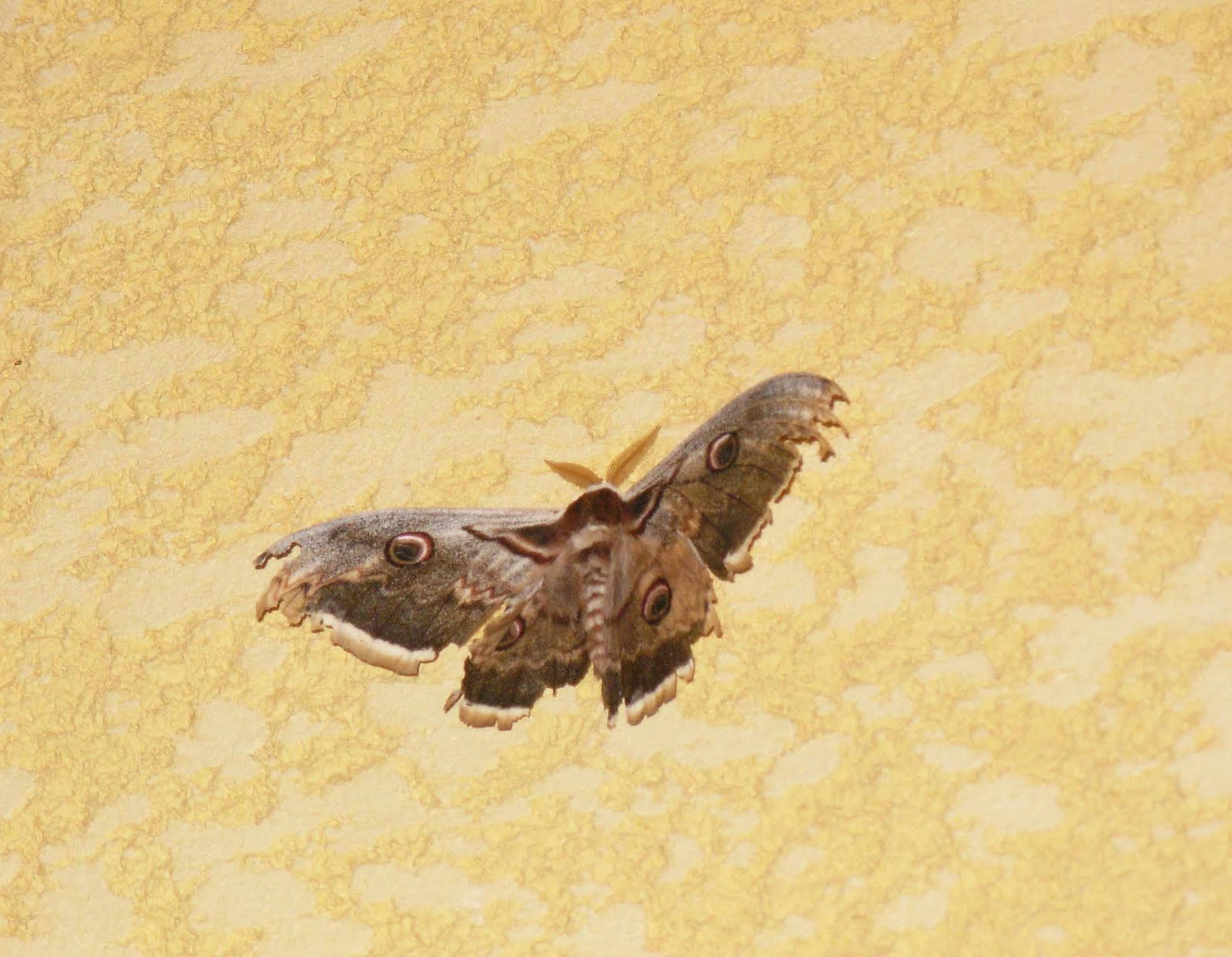
My attention was also drawn to a large moth under the terrace lights. Closer inspection and a camera revealed a very battered Giant Peacock Moth.
Migrants continue to arrive
Another fantastic day and it began for us today by being taken by our good neighbours John & Hanne to Narbonne where we loaded up a trailer with free soil created by green recycling. A fantastic operation providing a good service for local people. Our chalky boulder clay flower beds will welcome a bit of variety.
Sitting on the terrace at lunch time a Nightingale was singing close by and then I could clearly pick out the "hurdy gurdy" song of Western Orphean Warbler. I have a feeling that this was a bit earlier than last spring. Even more surprising was a Roller flying high north and passing over the house. It is normally the end of the month before I see this species.
During the afternoon we went out again with our neighbours to look at the plethora of wild flowers out on the garrigue. We were particularly interested to look at some fritillaries known as Pyrenean Snakeshead which we had discovered a few days earlier. They were still looking pretty good. A Short-toed Eagle flew overhead and at another site a Western Bonelli's Warbler sang.
Back at home and gazing out of the window produced a splendid male Pied Flycatcher feeding from an almond tree.
Roll on tomorrow.
Friday, 15 April 2011
The Spread of the Phsycadelic Moorhen
When I was very young I somehow acquired a stuffed Purple Swamphen or Purple Gallinule as it was then known. At the time we got the thing we had no idea what it was. The Observers Book of Birds did not cover such exotica and it was known affectionately as "The Phsycadelic Moorhen". Only when the first Peterson Guide arrived did we discover its identity and also that its grey head made it the race found in Asia.
Now for years the closest place for British birders to catch up with this species has been the Iberian Peninsula and to the far south especially Coto Donana in Spain. More recently this spectacular bird was introduced into the Ebro Delta Spain's second great wetland. From here these birds have moved north to the Gulf of Roses and even more recently crossed into France. They have done so well they are now in the Camargue.
In Languedoc they are now quite regularly seen in coastal reedbeds and inland a bit near Capestang. As elsewhere in Europe they are very difficult to see skulking in dense reeds and only occasionally showing themselves. This species is widespread and they are certainly easier to see elsewhere. In India I saw them feeding in the open in filthy pools by Bharatpur, and in Wester Australia we had to fend this purple pest off as it regularly jumped onto our picnic table at Herdsman's lake in Perth in an attempt to steal our lunch.
I was lucky recently to get three views in a morning in France. One walked across the path, another got up at my feet and flew powerfully across the marsh and a third swam out and posed with a Mallard.
My photos show the latter and an Australian bird posing.
How long before they reach the UK?
Connected at last! News from France
I am none the wiser at how France Telecom/Orange work but today we got connected 5 days before we expected it. So here is a round up of wildlife news from France so far.
Arriving on April 1st the first migrant in the garden was a female Redstart followed by a Black Kite a few minutes later. A small group of Willow Warblers passed through before dusk. April 3rd was the next chance for a look round and 8 Swallows moving through first thing was followed by a very active Hoopoe. In fact Hoopoes have become a daily sight since. I checked the local Lac de Jouarre and apart from 30 more Swallows nothing much yet. Back at home a Red Kite and a Cuckoo were the highlights of April 4th and a pair of Short-toed Eagles were April 5th.
On April 6th we made our first excursion to the coast. Starting at Etang de Vendres we watched feverish activity at the heronry with Grey Herons, Cattle & Little Egrets all busy with nesting. In the surrounding reeds a couple of Purple Herons appeared and Black Kites and Marsh Harriers flew overhead. We moved south to Pissevache and found 27 Avocets on the shallow lagoon with about 30 Sandwich Terns. Close to the sewerage works c100 Greater Flamingos loafed around but 3 Slender-billed Gulls raised the adrenalin. White and Blue-headed Wagtails were obvious in the salt marsh before we moved on to the Gruissan area. At Mandaric c30 Spotted Redshanks fed with a couple of Black-winged Stilts and another Purple Heron flew over.
On April 7th we walked over the garrigue behind our house and it was soon apparent that Subalpine Warblers were well in with singing birds widespread. A male Redstart looked superb in a blossom tree also visited by Hummingbird Hawkmoth and a Scarce Swallowtail. Two male and a ring-tail Montagu's Harriers floated over the Cesse Gorge and a Wheater perched by open grassland.
On the evening of April 8th we enjoyed a pizza in the ancient village of Minerve and as we walked back to the car in the evening sun 3 Crag Martins and 2 Red-rumped Swallows circled above the church tower and 2 Blue Rock Thrushes cavorted on the roof tops.
On April 10th I went with my friend Stuart Gregory to a lonely gorge where we watched for an hour or so a Bonelli's Eagle sitting peacefully on its nest. This is our nearest nest and is onbe of only 29 in France. There have been successful here for several years. As we left a Firecrest was singing loudly.
On April 11th we took another walk around the local garrigue stooping first to admire flowering Wild Tulips. 10 House Martins went over followed by a female Montagu's Harrier. A bit later eagle-eyed Beryl picked up a high flying Griffon Vulture heading north. Lots more Subalpine Warblers and a single Whitethroat were pleasing but just before reaching our gate we came across a Western Bonelli's Warbler singing in a neighbour's garden. Taking a drive later back to woods in the hills we found another 3 singing.
April 13th saw me heading for the large marsh just south of Capestang. Very heavy rain in March has left high water levels with some fields flooded that I have never seen damp in 10 years. I took the usual walk across the centre of the marsh. Black Kites and Marsh Harriers soared overhead and hordes of Grey Herons and Little Egrets flew up from reeds and 5 Great White Egrets were still present. Soon a few Purple Herons took to the sky and a single White Stork headed north. Over a hundred Blue-headed Wagtails fed by the track and a few Reed Buntings were in song. A single Coypu (remember them?) startled me by dropping into the water and then watching me from a safe distance.
Reaching the dense reedbeds a few Reed Warblers and a Sedge Warbler were singing and then a couple of Great Reed Warblers struck up with their guttural deliveries. The marsh was noisy now and the many squeals turned out to be Purple Swamphens and 3 were seen (see next blog). I turned and started my walk back just in time to note 2 Alpine Swifts heading north with larger numbers of Sand Martins. Stopping by one of the flooded meadows I picked out 6 Whiskered Terns, 20 Greenshanks and c60 Black-winged Stilts amongst hundreds of Black-headed Gulls.
Right up todate today we once again headed for the coast driving out onto Gruissan beach. A few Wheatears were all we found there but at Mandirac the Spotted Redshanks were still present accompanied now by a Wood Sandpiper. Finally on the way home a Great Spotted Cuckoo flew across the road just west of Narbonne.
So far wonderful and with some amazing weather. On two days temperatures hit 33 degrees but thankfully now a more manageable 23.
Tuesday, 12 April 2011
No internet in France
Very frustrating that I have no internet connection and will not get one until April 20th. I am usinga friend's connection.
Spring is very obvious here with two days when temperatures reached 33 degrees. Migrants are arriving daily. So far lots of Subalpine Warblers are singing plus one day of Bonelli's Warblers everywhere. Hoopoes are displaying as I write this and a cock Redstart resplendant in a cherry tree.
No Nightingales yet so we wait for their songs keeping us awake at night.
More soon
Subscribe to:
Posts (Atom)